- Admissions Open | New Batches
Take Our German Language Course and Build Your Future
German for Students | German for Workplace | German for Relocation | German for Business
Learn German through our live instructor-led classes from experts. With our German language course we cover all levels of CEFR, from German A1 to German C2.
60 Guided Hours at Each CEFR Level (A1 to C2)
Goethe Exam Preparation Across All Levels
One-on-One Native Speaker Interaction
4.8/5
2,518 Learners
Book a Demo Class
WHY START NOW
A German Language Course Built Around Your Goals
Master German A1 to German C2
Whether you’re starting at A1 or aiming for C2, we prepare you for every CEFR stage
60 Guided Hours for Each Level
Highly interactive expert-led sessions in small batches so that your preparation is top-notch
German Native Speaker Interaction
Test your German, reflect on your ability, and feel more prepared
Goethe-Zertifikat Preparation
Prepare for the Goethe-Zertifikat with focused German language training
Our German Language Courses Help Address Real-life Challenges
German Skills for Studying in Germany
- Handle German Bureaucracy
- Manage Daily Life
- Understand German Lectures
- Handle German Bureaucracy
- Write Academic German
- Participate in Seminars
- Prepare for Language Exams
German Skills for Working in Germany
- Master German Job Applications
- Ace German Job Interviews
- Understand Workplace German
- Communicate Confidently at Work
- Navigate Workplace Culture
- Build Professional Connections
German Skills to Move to Germany
- Understand Official German
- Communicate With Landlords
- Handle German Bureaucracy
- Navigate Everyday Conversations
- Understand German Contracts
- Build Local Connections
German Skills to Work with German Clients
- Communicate Professionally in German
- Master German Business Etiquette
- Handle Client Conversations
- Lead Meetings Confidently
- Present Ideas in German
- Write Professional German Emails
Your German goals are unique. Tell us what you’re preparing for, and we’ll help you find the right learning path.
Who is Our German Language Course for?
Our German course brings together a diverse community of learners with different goals, backgrounds, and proficiency levels. Learn alongside peers, exchange experiences, and grow together throughout your German journey.
German for Career & Business
- German Language Course for Nurses
- German Course for Doctors
- German for IT Professionals
- Business German for Engineers
- German Job Interview Preparation
- Corporate German Language Training
German for Study, Exams & Ausbildung
- German Language Requirements for Ausbildung
- Goethe Exam Preparation Online
- TestDaF Preparation Course
- DSH Exam Preparation
German for Family Relocation
- German A1 Course for Spouse Visa
- German Language Classes for Kids
German Language Course Highlights
Go beyond the basics with a German Language Course designed around practical, structured learning. Explore the features that make your learning experience more focused, flexible, and effective.
Live Online & In-Person German Training
Choose the format that works for you with live German classes available online or in person. Learn through structured instruction while progressing through your chosen CEFR level.
Real-Life Tasks & Role-Play
Learn German through real-life tasks and role-plays that turn language knowledge into practical communication. Build the ability to use German across everyday and professional situations.
German-Only Immersion from B1
From B1 onward, learning takes place in German, creating a more immersive environment as your proficiency develops. This helps you engage with German at an independent-user level
Authentic German Content & Accents
Learn with authentic press articles, podcasts, and videos from Germany, Austria, and Switzerland. From B1 onward, exposure to regional accents helps broaden your understanding of spoken German.
Weekly Progress Assessments
Track your German development through weekly formative quizzes and ongoing oral check-ins. Regular assessment helps measure your progress against the can-do goals of your CEFR level.
Skill-Specific Improvement Suppor
Identify areas that need more attention through regular assessment. From B1 onward, learners who need additional support after the final mock can receive supplementary sessions focused on specific language skills.
Official Goethe Materials Integrated
Prepare with official Goethe-Institut Modellsätze, exam specifications, and preparation guides integrated into your learning. Goethe-style tasks are introduced well before the final mock exam
Audio & Video Learning Resources
Access an audio and video library through the Wila learner portal to complement your classroom learning. Resources include exposure to regional accents from B1 onward.
Audio & Video Learning Resources
Access an audio and video library through the Wila learner portal to complement your classroom learning. Resources include exposure to regional accents from B1 onward.
German Language Training Backed by and Established Institution
Win In Life Language Academy is part of a broader education ecosystem built by WILA and CliniLaunch Research Institute, bringing established experience in career-focused and professional learning to German language training.
20,000+ Learners Trained
A proven learning ecosystem across diverse markets.
10,000+ Learners Certified
A strong track record in professional certification.
500+ Hiring Partners
Strong industry connections across multiple career domains.
Multiple Career Domains
Expertise spanning technology, healthcare, business, and life sciences.
Not sure which level your goal needs?
Our Placed slider

Course Curriculum
Main topics
- Introduce yourself, countries and occupations
- The alphabet and the numbers
- Languages and countries
- People and hobbies
- The work and the workplace
- Free time and daily activities
- At the hotel
- The city map and asking for directions
- Food and drink in the restaurant
- Shopping, prices and paying
Grammar
- Personal pronouns and verbs in the present tense
- The group of nouns: der / die / das
- Regular, irregular and separable verbs
- The negation: nicht and kein
- Prepositions of place
- Personal pronouns in the accusative case
- Definite and indefinite articles
- W-questions and yes / no questions
- The imperative for instructions
- Modal verbs: können and möchten
Main topics
- Daily schedule and routines
- Stress in the office
- On the computer
- Arranging appointments
- The seasons and the weather
- Destinations and travel preparations
- Means of transport
- Living and the home furnishings
- Health and the visit to the doctor
- Excuses and apologising
Grammar
- The perfect tense with haben and sein
- Prepositions of time
- Sentence connectives: conjunctions
- The dative case and the group of nouns
- Indicators of space: wo and wohin
- Adjective endings after articles
- Comparative and superlative forms
- Modal verbs in the simple past
- Reflexive verbs
- Subordinate clauses with weil and dass
Main topics
- Education, training and Ausbildung pathways
- Applying for work and the job interview
- Media, internet and social networks
- Money, banking and contracts
- Relationships and family life
- Settling into life in a new country
- Environment and everyday sustainability
- Culture, festivals and traditions
- Making complaints and resolving problems
- Plans, goals and future intentions
Grammar
- The simple past of common verbs
- Relative clauses and relative pronouns
- The passive voice in the present tense
- Konjunktiv II for polite requests and advice
- The genitive case
- Two-way prepositions with dative and accusative
- Verbs with fixed prepositions
- Infinitive clauses with zu
- Temporal clauses: als, wenn, nachdem
- Indirect questions
Main topics
- The German workplace and professional communication
- Presentations, meetings and discussion
- Study and academic life in Germany
- News, current affairs and opinion
- Science, technology and innovation
- Health systems and professional contexts
- Migration, integration and society
- Arguing a position and negotiating
- Formal correspondence: emails and letters
- Discussing literature and film
Grammar
- The passive in all tenses, including with modal verbs
- Konjunktiv I for reported speech
- Extended participial phrases
- Nominalisation and Funktionsverbgefüge
- Concessive and consecutive clauses
- Subjective use of modal verbs
- Complex connectors: je … desto, sowohl … als auch
- Word order in complex sentences
- Prepositional adverbs: darauf, worauf, damit
- Register: formal versus informal
Main topics
- Academic German for university study
- Abstract and specialist subject matter
- Debating and structured argumentation
- Business German and professional negotiation
- Analysing German-speaking media
- Idiomatic and colloquial expression
- Writing structured essays and reports
- Summarising long and complex texts
- Regional variation across Germany, Austria and Switzerland
- Presenting research, data and findings
Grammar
- Advanced Konjunktiv I and Konjunktiv II
- Passive alternatives (Passiversatzformen)
- Participle constructions I and II
- Nominal versus verbal style
- Advanced modal particles: doch, ja, mal, eben
- Complex prepositional and genitive constructions
- Ellipsis and text cohesion
- The sentence bracket and emphasis
- Advanced word formation
- Controlling stylistic register
Main topics
- Near-native fluency across all contexts
- Nuance, irony and implied meaning
- Specialist and academic discourse
- Analysing literary and journalistic texts
- Comprehending fast, unmodified speech
- Persuasive and rhetorical speaking
- Precise professional writing
- Culture-specific references and humour
- Spontaneous debate on abstract topics
- Editing and refining your own German
Grammar
- Full command of all tenses, moods and voices
- Subtle distinctions in modality
- Advanced idiomatic and figurative language
- Complex hypotactic sentence structures
- Stylistic variation and rhetorical devices
- Formal and archaic constructions in written German
- Fine-grained use of connectors
- Text-type-specific conventions
- Self-correction and error refinement
- Nuanced register switching
Main topics
- Introducing yourself professionally in German
- Telephone and video-call etiquette
- Writing professional emails in German
- Small talk and workplace conversation
- Giving and receiving feedback politely
- Presenting confidently to a group
- Working in intercultural teams
- Handling misunderstandings and clarifying
- Appointment and punctuality culture in German-speaking countries
- Everyday politeness: Sie versus du
Practice focus
- Role plays in workplace scenarios
- Recorded speaking tasks with instructor feedback
- Peer practice in the weekly speaking clubs
- Model phrases for meetings and calls
- Common formal and informal expressions
Main topics
- The German Lebenslauf: format and conventions
- Writing an Anschreiben (cover letter)
- Vocabulary for qualifications and experience
- Describing your language skills at CEFR levels
- Reading and decoding German job advertisements
- Preparing for a German-language interview
- Common interview questions and model answers
- Document sets for Ausbildung and university applications
- Formal register in application writing
- Proofreading your own application German
Practice focus
- Draft and revise a full Lebenslauf in German
- Draft and revise an Anschreiben
- Mock interview in German with instructor feedback
- Vocabulary bank for your own field
- Checklist for a complete German application
Why Learners Choose Our German Course
Questions people actually ask
The German Language Course covers all six CEFR levels, from German A1 through German C2.
Yes. No prior German knowledge is required to begin the German A1 course.
Yes. Entry into subsequent levels requires a prior level certificate or placement test.
Each German Course level includes 60 guided instructional hours, with 40 additional self-study hours recommended.
Classes are live, delivered through instructor-led online or in-person German Language Course sessions.
Yes. The German Course is available through both live online and in-person learning formats.
German Course groups accommodate up to 12 learners, while C1 and C2 groups have a maximum of eight.
Yes. The German Course offers a weekend format for learners balancing language training with other commitments.
Yes. Intensive German Course learning is available at eight guided hours per week.
Yes. Choose regular, intensive, weekend, or super-intensive German Course formats based on your preferred pace.
The German Language Course develops listening, reading, writing, and speaking skills across every CEFR level.
The German Course follows a communicative, task-based approach using real-life tasks and role-plays alongside structured grammar learning.
Yes. Real-life tasks and role-plays help learners apply German in practical communication situations.
Yes. Professional communication becomes increasingly prominent across the B1 to C2 German Course levels.
Yes. Academic writing, formal communication, presentations, and advanced academic language feature prominently from B2 onward.
Yes. The German Course develops formal registers through writing, presentations, professional communication, and advanced language use.
Yes. Authentic regional accents from German-speaking regions are introduced from B1 onward.
Yes. The German Language Course prepares learners for Goethe-Zertifikat examinations from A1 through C2.
Yes. Goethe preparation develops listening, reading, writing, and speaking skills across every German Course level.
From B1 onward, supplementary consolidation sessions address individual skills requiring additional support after the final mock.
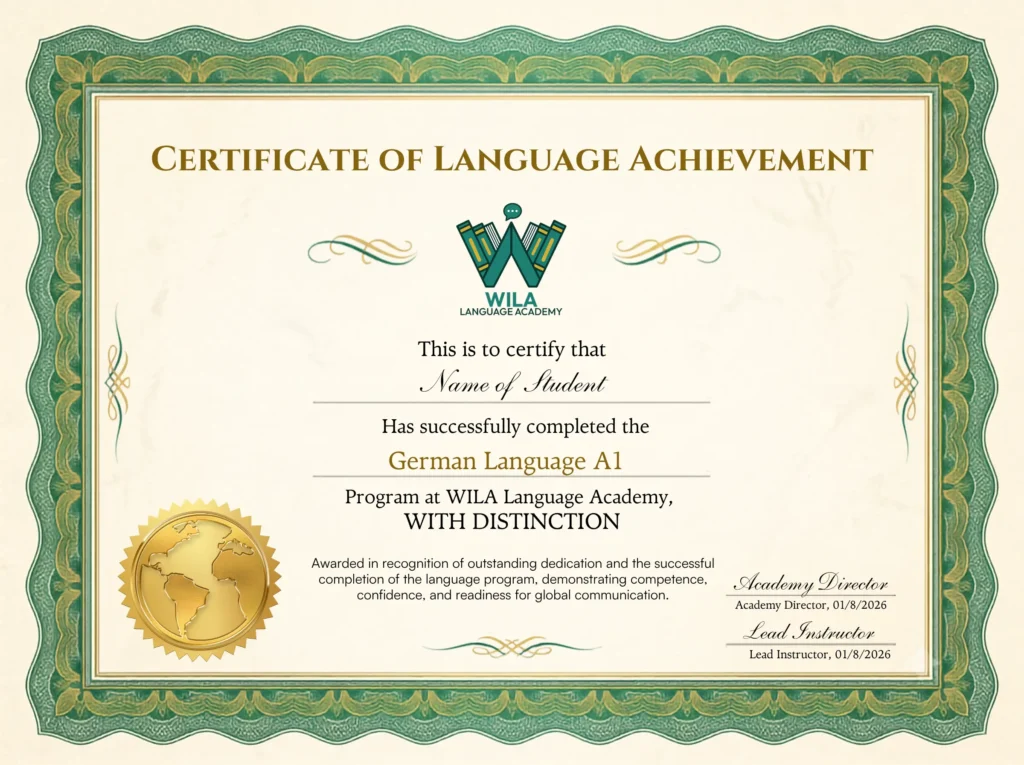
Yes. Learners receive a Wila Certificate of Completion after successfully completing each German Course level.
No. The official Goethe-Zertifikat requires separate exam registration and fees through an accredited examination centre.
Yes. Learners can register for the corresponding official Goethe-Zertifikat exam after completing their German Course level.
You achieve the CEFR level corresponding to the German Course you successfully complete, from A1 through C2.
Each German Course level develops specific listening, reading, speaking, and writing abilities defined by the corresponding CEFR outcomes.
Submit your details through the enquiry form, and our team will guide you through the German Course admission process.
The German Course offers in-person delivery, while specific classroom locations should be confirmed with our admissions team.
Yes. Regular, weekend, intensive, and super-intensive formats offer options for different schedules and time commitments.
Yes. The weekend German Course format provides six guided hours weekly across two three-hour sessions.
Depending on your chosen format, one German Course level takes approximately five to fifteen weeks to complete.
- 4.9/5 on Google
Searching for German language classes near me? Start with a free assessment.
Book a free demo and placement assessment for the German language course near you. No prior German needed, we’ll tell you where to start and walk you through admission.
Download Course Brochure
- Bangalore
- Hyderabad
- Chennai
- Pune